
Welcome to another informative piece by Green Schools Green Future. With your support, we can build a school in which students receive interactive education to equip them with future-ready skills. Our immersive, outdoors activities will be connected to ecology, biology, math, and basic chemistry. This allows students to understand the value of the outdoors while receiving a high quality education.
Understanding nutrition and food is a key topic we will teach students. This blog will shed some insight into common candies.
A Closer Look at Halloween Candy
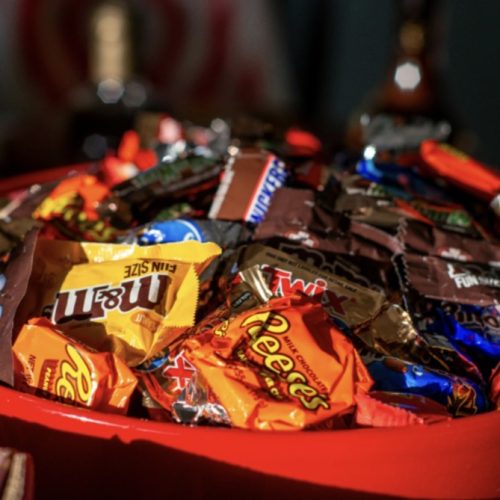
Every October, grocery store shelves transform into walls of neon gummies, sour candies, chocolate bars, and brightly coloured treats. But turn over one of those wrappers and the ingredient list might look more like something from a chemistry lab: Red 40, soy lecithin, citric acid, sorbitol, potassium sorbate, and artificial flavours. While these names can sound intimidating, food additives serve specific purposes. As food science advances, some familiar ingredients can even be produced using microorganisms in laboratories. So, what exactly is hiding behind the wrapper?
Why Is Halloween Candy So Colourful?
Artificial colours remain an active area of scientific research. A 2022 systematic review published in Environmental Health examined evidence concerning synthetic food dyes and behavioural effects in children. The researchers concluded that the evidence linked exposure to certain dyes and behavioural effects in some children. Other research has found relatively small effects while highlighting limitations such as differences between studies and methods of measuring behaviour.
Health Canada has stated that the evidence has not established that synthetic food colours cause behavioural effects. The disagreement is a useful reminder that food-safety science can continue evolving even after an additive has been approved for use.
Why Can Candy Sit Around for So Long?
A chocolate bar or hard candy can survive in your Halloween stash considerably longer than a bowl of strawberries. Part of the explanation comes down to water activity. Microorganisms need water to grow, and many candies contain relatively little water. High concentrations of sugar can further limit microbial growth. Some foods also contain preservatives that inhibit bacteria, molds, or yeasts or slow chemical reactions that affect flavour and quality.
This is also why the idea that “chemicals equal danger” doesn’t work very well scientifically. Toxicology depends heavily on dose and exposure. A substance capable of causing harm at one concentration might pose very little risk at another. Food-safety agencies therefore evaluate not simply whether an ingredient can produce an effect, but how much people are likely to consume and whether that exposure falls within established safety limits.
The Next Generation of Candy: Lab-Grown Ingredients
Some ingredients in future candy might not begin in a field at all. Advances in biotechnology allow scientists to use microorganisms as microscopic factories through processes such as precision fermentation and microbial bioconversion. Traditional fermentation already relies on microorganisms to make familiar products such as bread and yogurt. Modern biotechnology can modify or select microorganisms so that their metabolic pathways produce specific proteins, flavours, pigments, fats, or other useful molecules.
Vanillin, the molecule primarily responsible for vanilla’s characteristic aroma, is one example. Natural vanilla beans are expensive and labour-intensive to produce, and researchers have developed microorganisms capable of converting compounds such as ferulic acid and eugenol into vanillin. Scientists are also investigating metabolic engineering to make these biological production methods more efficient. Similar biotechnology approaches are being investigated for food colours, proteins, fats, and cocoa-related ingredients.
Calling all of these products “lab-grown,” however, can oversimplify the science. Precision fermentation can be considered different technologies depending on if they use microbes, plant-cell cultivation, or cultivated animal cells. What matters scientifically is not simply whether an ingredient originated on a farm or inside a fermentation tank, but what was produced, how it was purified, how much people consume, and whether the final ingredient has been demonstrated to be safe.
Should You Be Scared of the Ingredient List?
Probably not because you can’t pronounce it. Ascorbic acid is vitamin C, tocopherols are forms of vitamin E, and citric acid occurs naturally in citrus fruits. Conversely, being “natural” doesn’t automatically make something harmless. Chemical identity, dose, metabolism, and exposure provide far more useful information about safety than whether an ingredient sounds natural or artificial.
At the same time, food additives remain under scientific scrutiny. Researchers continue investigating dyes, sweeteners, preservatives, and emerging biotechnology, while regulators can reconsider how ingredients are used as evidence develops.
So this Halloween, take another look at the back of the wrapper. That tiny ingredient list contains lessons in chemistry, microbiology, toxicology, and biotechnology — and the scariest-looking ingredient might not actually be the scary part at all.
If you liked this blog, sign up for our monthly newsletter!
Our Mission & Closing Remarks
At GSGF, we are pushing for hands-on green education to empower students. We will incorporate outdoor lessons and green practices into our curriculum. This includes lessons about the school farm and the various plants that are being grown to feed the school community. By combining education with real-world environmental action, Green Schools Green Future is planting the ideas, skills, and values that our youth need to make our future a sustainable one. Our students are empowered to make a meaningful impact in their communities.
With a donation to our new GoFundMe campaign, we can continue to grow this vision. Any amount counts, together we can nurture the next generation of changemakers.
Resources:
https://www.canada.ca/en/health-canada/services/food-nutrition/food-safety/food-additives/lists-permitted.html
https://www.canada.ca/en/health-canada/services/food-nutrition/food-safety/food-additives/colours.html
https://www.fda.gov/food/food-additives-and-gras-ingredients-information-consumers/types-food-ingredients
https://pubmed.ncbi.nlm.nih.gov/35484553/
https://www.advancesinpediatrics.com/article/S0065-3101(16)30017-2/abstract
https://www.iarc.who.int/news-events/aspartame-hazard-and-risk-assessment-results-released/