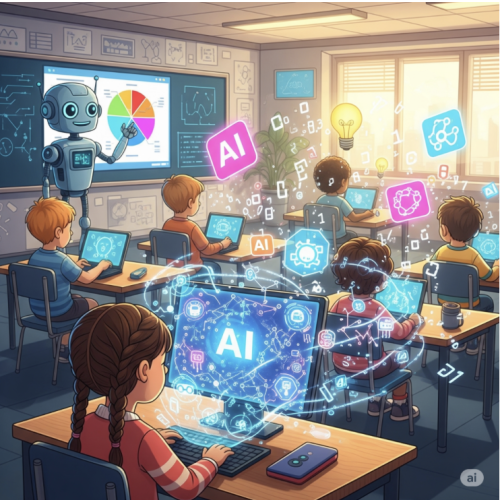

Recent AI education news and what responsible innovation could mean for schools.
Artificial Intelligence Is Moving Into Education
Artificial intelligence is becoming part of everyday education. The conversation is moving beyond whether or not schools should use AI and toward how they can use it responsibly. In 2026, UNESCO published a new collection examining the educational, ethical, and social questions created by AI. Meanwhile, the Organisation for Economic Co-operation and Development highlighted Estonia’s AI Leap initiative, which began integrating AI into general and vocational education during the 2025 to 2026 school year (OECD, 2026; UNESCO, 2026).
At Green Schools Green Future, we believe schools must prepare students to understand the technologies shaping their communities, future workplaces, and the planet.
The latest policy direction also emphasizes understanding technology rather than using it passively. In July 2026, the European Commission published informatics guidelines that encourage students to learn how digital systems work, moving beyond basic coding and general digital skills (European Commission, 2026).
A Green AI Curriculum With Personalized Learning
One of the most discussed benefits of AI in education is personalized learning. Adaptive tools can provide explanations, examples, and practice activities according to a student’s progress. They can also provide immediate feedback, which may help learners identify their weaker areas before those gaps become larger. The World Bank notes that AI may help students catch up and remain engaged when personalized instruction is designed around clear learning goals with support from teachers (World Bank, 2025a).
Personalization can be especially useful in classrooms where students learn at different speeds or require different forms of support. AI-enabled tools offer text to speech, speech to text, translations, simplified instructions, and alternative ways to interact with content.
An OECD review found that artificial intelligence and other digital technologies may support students with special education needs, although accessibility and teacher oversight remain essential (Linsenmayer et al., 2025). These tools should help rather than replace teachers, since AI works best with human review/supervision.
AI Literacy Is Becoming a Core Student Skill
Schools once taught students how to search the internet and critically think about information they find online. They must now teach students how to evaluate AI outputs. UNESCO’s AI competency frameworks emphasize a human-centered approach, ethics, foundational knowledge, and the ability to design or use AI responsibly (UNESCO, 2024a, 2024b).
Responsible AI in schools includes:
- Knowing that a confident answer may still be wrong
- Identifying missing evidence
- Protecting personal information
- Recognizing that AI can reproduce social bias
AI literacy can also strengthen creativity when students remain active participants. A class might compare an AI-generated explanation with a scientific source, identify weak assumptions in a proposed climate solution, or improve a prompt after evaluating an incomplete response. These activities turn AI into an object of inquiry rather than an answer machine.
UNESCO cautions that educational institutions need to test and validate AI applications before rolling them out, particularly when children’s personal data and learning outcomes are involved (UNESCO, 2023).
AI for Environmental Learning & Innovation
An AI-assisted curriculum can support environmental learning when it is connected to real evidence and hands-on experience. Students might analyze school energy use, study local weather patterns, compare food waste measurements, or model the water needs of a garden. These projects can connect mathematics, science, technology, and environmental responsibility while making abstract information easier to explore.
GSGF’s mission is grounded in practical green education, and AI can complement that work when technology leads students back to observation, experimentation, and community action. We are building a school where students will learn about sustainability, technology, clean energy, agriculture, and healthy cooking through hands-on activities.
Learn more about our school project.
Schools should also discuss the environmental footprint of AI itself. Data centres require electricity, water, hardware, and mineral resources, so digital innovation should not be treated as impact-free.
The International Energy Agency projects that electricity demand from data centres will rise substantially through 2030, with AI as an important driver of that growth (International Energy Agency, 2025). Students deserve an honest discussion about both the benefits of AI and the responsibility to develop more efficient systems powered by cleaner energy.
What Responsible AI Adoption Looks Like
Schools with AI in their curricula do not need to adopt every new tool. A careful process begins with a specific educational need, followed by privacy review, teacher testing, accessibility checks, and clear rules for student use.
The U.S. Department of Education’s 2025 guidance identified responsible adoption, educator support, and improved teaching and learning as priorities for AI use in schools (U.S. Department of Education, 2025). Families should also understand what information a tool collects, how long it keeps that information, and whether student work is used to train commercial systems.
Assessment methods must change as well. When students can generate text quickly, teachers need assignments that reveal reasoning and deeper understanding. Oral explanations, project journals, classroom discussion, source comparisons, practical demonstrations, and local investigations can help educators see how a student reaches a conclusion. OECD analysis continues to stress that technology contributes to learning only when pedagogy, governance, and professional skills develop alongside it (OECD, 2023).
AI as a Tool for Good
Artificial intelligence offers useful possibilities, but educators should decide its purpose.
Used responsibly, AI can help teachers prepare resources, give students additional practice, improve accessibility, and build the critical digital skills young people need. Used carelessly, it can spread inaccurate information, weaken privacy, increase inequity, and encourage students to skip the thinking that produces real learning. UNESCO’s current work calls for AI systems that advance inclusion and opportunity while remaining accountable to people (UNESCO, 2026).
At GSGF, we believe the strongest education combines innovation with human relationships, practical skills, and responsibility for the natural world. You can support the development of our first green school by subscribing to our newsletter. Small actions help create learning environments where technology serves students, teachers, communities, and the planet.
Be Part of the GSGF Mission
Green Schools Green Future is working to build Canada’s first hands-on green school, where students can connect academic learning with sustainable agriculture, clean technology, environmental responsibility, and practical life skills. GSGF is now securing land and donations will help move the project from plans to a physical school designed for future green leaders.
Your contribution will help us build a school where students will learn about sustainability, technology, clean energy, agriculture, and healthy cooking through hands-on activities.
If you are unable to donate today, you can still help by sharing our project with educators, families, businesses, and community partners. You can also get involved as a volunteer. Every donation, partnership, volunteer, and shared message helps bring hands-on green education closer to the students who will lead us into a more sustainable future.
References:
Department for Education. (2025, June 10). AI in schools and colleges: What you need to know. https://educationhub.blog.gov.uk/2025/06/ai-in-schools-and-colleges-what-you-need-to-know/
European Commission. (2026, July 27). Enhancing digital skills: Informatics guidelines and EU support. https://education.ec.europa.eu/focus-topics/digital-education/action-plan/action-10
Fayiza. (2025, August 16). Children using laptops with colorful AI-themed icons like robots, a brain, and code [Digital illustration]. MeeM Academia. https://meemacademia.com/ai-for-kids/
International Energy Agency. (2025). Energy and AI. https://www.iea.org/reports/energy-and-ai
Linsenmayer, E., et al. (2025). Leveraging artificial intelligence to support students with special education needs. OECD Publishing. https://www.oecd.org/education/
Organisation for Economic Co-operation and Development. (2026, June 23). Developing vocational education and training with artificial intelligence. https://www.oecd.org/
U.S. Department of Education. (2025, July 22). U.S. Department of Education issues guidance on artificial intelligence use in schools. https://www.ed.gov/about/news/press-release/us-department-of-education-issues-guidance-artificial-intelligence-use-schools-proposes-additional-supplemental-priority
UNESCO. (2023). Guidance for generative AI in education and research. https://unesdoc.unesco.org/ark:/48223/pf0000386693
UNESCO. (2024b). AI competency framework for teachers. https://unesdoc.unesco.org/ark:/48223/pf0000391104
UNESCO. (2026). AI and the future of education: Disruptions, dilemmas and directions. https://unesdoc.unesco.org/
World Bank. (2025a, June 26). AI in schools: Opportunities, challenges and realities for the classroom. https://www.worldbank.org/en/topic/edutech