
Cabbage may not be the most exciting vegetable at first glance, but it has many qualities that make it valuable in school communities. It is affordable, versatile, widely available, and can be used to introduce students to nutrition, gardening, cultural traditions, food systems, and waste reduction. The Food and Agriculture Organization of the United Nations (FAO, 2021) recognizes that increasing access to fruits and vegetables can contribute to healthier diets and more sustainable food systems.
For sustainable schools like GSGF, ordinary ingredients like cabbage can become powerful educational tools. Students can follow the vegetable from seed to plate while developing practical skills and learning how everyday food choices affect personal health, local communities, and the environment.
Cabbage: A Vegetable With Important Nutrients
Cabbage belongs to the cruciferous vegetable family, alongside broccoli, cauliflower, kale, and Brussels sprouts. These vegetables provide fibre and several essential nutrients, including vitamins C and K and folate (National Cancer Institute [NCI], 2012).
Cruciferous vegetables also contain natural plant compounds called glucosinolates. When these vegetables are chopped, chewed, and digested, glucosinolates form biologically active compounds that researchers continue to study for their potential health-supporting properties (NCI, 2012). Cabbage is not a miracle food, but it can be a nutritious and accessible part of a varied diet.
Canada’s Food Guide recommends making vegetables and fruits half of your plate. It also lists red cabbage as a nutritious option (Health Canada, 2026a). School cafeterias can serve cabbage in soups, tacos, salads, sandwiches, stir-fried dishes, and grain bowls. Offering the vegetable in different ways can help students explore new flavours while getting a healthy energy boost for afternoon classes.
Learning From the Garden
Crops such as cabbage can connect several areas of the school curriculum. Students might measure plant growth in mathematics, learn about soil and insects in science, explore cultural food traditions in social studies, and practice reading and following instructions through recipes. School food activities can help children explore unfamiliar ingredients while developing practical food skills and healthier eating habits (Health Canada, 2026b). Our school will have a garden which students will maintain and nurture.
Red cabbage can even become part of a supervised science experiment. Its natural pigments, known as anthocyanins, change colour when exposed to acidic or alkaline substances, which allows red cabbage to act as a simple pH indicator (Yoshida et al., 2003). Even just one vegetable can connect nutrition, gardening, and science in a memorable way to help students grow.
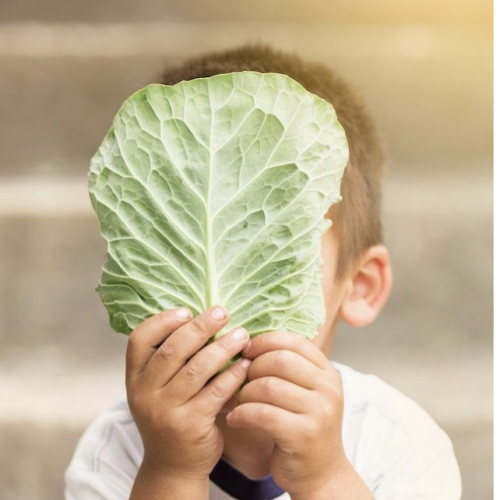
The image of a child holding a cabbage also represents the curiosity and personal connection that hands-on food education can encourage.
Supporting Food Security Education
Because cabbage generally lasts longer than other more delicate leafy vegetables, one head can spread across multiple meals. It might become a salad one day, a stir-fry the next, and part of a soup later in the week. Proper food planning and storage can help households and schools reduce unnecessary waste while making better use of available resources (FAO, 2019).
These conversations can help students understand that sustainability is not limited to growing food. It also involves respecting the water, energy, land, labour, and transportation needed to bring food from the farm to the table. Reducing food loss and waste can improve the efficiency of food systems and support broader environmental and social goals (FAO, 2019).
Reducing Food Waste at School
Although cabbage stores well, it can still be wasted due to poor handling, over-purchasing, or lack of meal planning. FAO (2023) found that poor post-harvest handling and quality control can contribute to significant losses throughout cabbage supply chains.
Schools can reduce waste by
- Purchasing only the quantities needed for activities and meals
- Rotating older produce to the front
- Storing vegetables correctly
- Planning meals
- Composting suitable scrap
Students can participate by conducting a cafeteria waste audit. They could measure how much cabbage is served, eaten, and discarded before suggesting changes to recipes or portion sizes. Our upcoming green school will incorporate activities like these to transform food waste from an abstract environmental problem into something students can observe, measure, and help improve.
Now Is the Time to Act
This summer, you can support green schools for a better future in simple but meaningful ways:
1. Support GSGF’s GoFundMe Campaign
We have entered the capital development phase of our first model green school project. The current goal is to raise funds toward land acquisition, an essential step before construction can begin.
The future school is designed to combine environmental education with practical learning through features such as solar energy, sustainable construction materials, green rooftops, vertical farming, and aquaponics. Every donation—regardless of its size—can help GSGF move closer to creating a place where students can develop practical skills and become future green leaders.
Donate to GSGF’s GoFundMe campaign.
You can also learn more about the GSGF Foundation and the school project.
2. Share the Message
Spread awareness about eco-friendly education and the importance of sustainable learning in Canada. Sharing this information can encourage more families, educators, and communities to participate.
3. Subscribe to Our Newsletter
Stay connected with GSGF’s mission through our monthly newsletter and discover new opportunities to create a meaningful, long-term impact.
Together, we can help students develop the knowledge and practical skills they need to build healthier and more sustainable communities.
References:
Food and Agriculture Organization of the United Nations. (2019). The state of food and agriculture 2019: Moving forward on food loss and waste reduction. https://www.fao.org/3/ca6030en/ca6030en.pdf
Food and Agriculture Organization of the United Nations. (2021). International year of fruits and vegetables 2021. https://www.fao.org/fruits-vegetables-2021/en/
Food and Agriculture Organization of the United Nations. (2023). Food loss analysis: Causes and solutions—Cabbage supply chain in Cianjur, West Java, Indonesia. https://openknowledge.fao.org/handle/20.500.14283/cc7684en
Health Canada. (2026a). Make healthy meals with Canada’s Food Guide plate. Government of Canada. https://food-guide.canada.ca/en/cooking-skills/make-healthy-meals-with-the-eat-well-plate/
Health Canada. (2026b). Toolkit for educators. Government of Canada. https://food-guide.canada.ca/en/educators-and-professionals/educational-resources/
National Cancer Institute. (2012). Cruciferous vegetables and cancer prevention. https://www.cancer.gov/about-cancer/causes-prevention/risk/diet/cruciferous-vegetables-fact-sheet
Yoshida, K., Mori, M., & Kondo, T. (2003). Blue flower color development by anthocyanins: From chemical structure to cell physiology. Natural Product Reports, 20(3), 303–312. https://doi.org/10.1039/B100897K