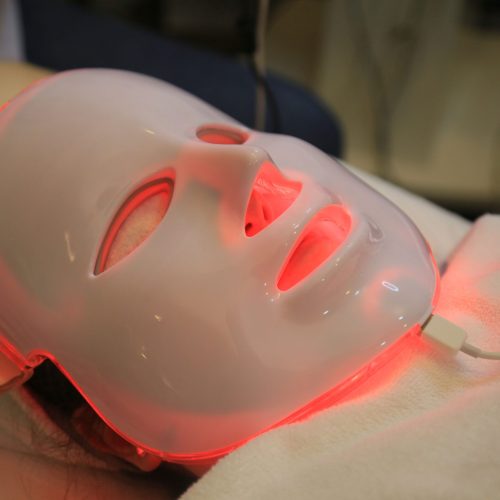

A few years ago, red light therapy sounded like something you would only find in a specialist’s clinic. Today, it has become part of a wider conversation about wellness. There are facial masks, handheld devices and full-body panels, all promising to help us look or feel better.
I can understand the curiosity. Most of us are looking for ways to care for ourselves without adding another demanding task to our day. Yet whenever a wellness trend becomes popular, I think it is worth asking what sits behind the claims.
Understanding Red Light Therapy
Red light therapy, also known as photobiomodulation, uses specific wavelengths of red or near-infrared light directed towards the skin. Unlike the ultraviolet light we associate with sun damage, these wavelengths don’t tan the skin.
Researchers believe that certain wavelengths may influence how our cells produce and use energy. Much of the discussion centres on mitochondria, the structures that help power our cells. This interaction may influence processes involved in tissue repair and inflammation. The science is still developing, however, and the effects depend on how the light is delivered.
What the Research Tells Us
Skin Health
This is one of the better-studied areas. Some clinical studies suggest that red light may:
- Improve the appearance of fine lines
- Improve skin texture and redness
- Encourage collagen production, which helps give our skin its structure and elasticity
These changes are generally modest rather than dramatic. In a 2025 Harvard Health article, dermatologist Dr. Rachel Reynolds explained that noticeable results can require repeated use over several months. This is a different picture from the instant transformations we often see on our social media feeds.
Hair Health
Researchers have also explored red light therapy for certain types of hair loss. Studies involving hereditary hair loss have reported improvements in hair density for some participants. That does not mean every form of hair loss responds in the same way. Still, it is an example of an area with growing evidence.
Physical Health
Another area of red light therapy attracting attention is physical recovery. Anyone who has returned to exercise after a long break will know how much the body can ache the following day. Some research suggests that targeted light therapy, particularly before exercise, may help reduce muscle soreness. However, research on full-body treatments has been less encouraging, so the results cannot be assumed to apply to every device.
Sleep Health
Sleep has entered the conversation as well. A 2026 review of five trials found possible improvements in sleep quality, but the evidence was limited and the treatments varied. It is too early to assume that an ordinary red light mask or panel will help everyone sleep better.
Making Room for Realistic Expectations
Perhaps the most useful way to approach red light therapy is as one possible addition to a wellness routine, rather than its foundation.
Not all devices work alike. Professional equipment may offer greater control over the intensity and amount of light delivered, while home devices can differ considerably. Researchers have not yet established the ideal exposure for every purpose, which makes sweeping promises difficult to justify.
Red light therapy appears reasonably safe in the short term when used appropriately, but it may not suit everyone. Certain medications and conditions increase sensitivity to light, and people with darker skin tones may be more susceptible to pigmentation changes. Following device instructions and taking eye proteupction seriously are important.
What interests me about red light therapy is not the promise of a quick transformation. It is the possibility that something as familiar as light may have uses we are only beginning to understand.
If you enjoyed this article, subscribe to our monthly newsletter for more insights on science, wellness and sustainability.
Our Mission & Closing Remarks
At Green Schools Green Future (GSGF), we believe that curiosity and critical thinking should begin early. Our vision is to build Ontario’s first hands-on green school, where students learn about science, technology and sustainability through real-world experiences. From growing their own food to exploring renewable energy, we want young people to understand the world around them and develop the skills to shape its future.
Bringing this vision to life requires community support. GSGF is currently raising funds to secure land and develop its first school. Every contribution brings us closer to creating a learning environment where the next generation can grow into thoughtful, responsible and environmentally conscious individuals.
Support GSGF’s Mission – Make a Donation
References:
https://www.aad.org/public/
https://my.clevelandclinic.
https://www.health.harvard.
https://pmc.ncbi.nlm.nih.gov/
https://pubmed.ncbi.nlm.nih.