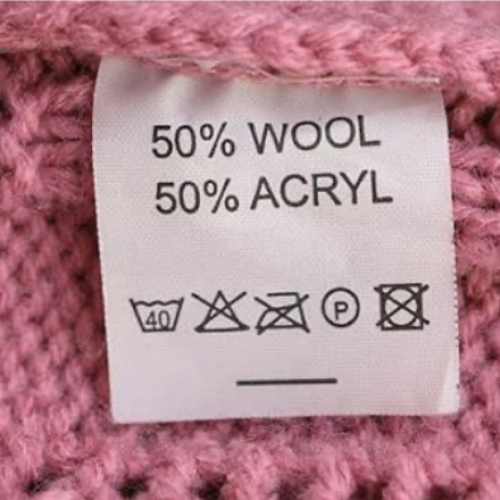

Most of us don’t expect to find plastic in a sweater, especially the soft ones we reach for when the weather turns cold. Take a look inside your favourite one. If the label mentions polyester, acrylic, or nylon, it contains synthetic fibres, which are types of plastic. They feel very different from a takeaway container, but they belong to the same broad family of materials.
The label tells us what went into the sweater. It doesn’t tell us what might come out of it.
That curiosity is what drives us at Green Schools Green Future (GSGF). We’re working to build Canada’s first green school, a place where students learn about sustainability by looking closely at everyday things, like the clothes we wear. So, let’s start with the label.
What Your Clothing Label Is Telling You
We usually check how clothing fits before we think about what it’s made from. A label can tell us whether something will stretch or shrink, but it also tells a story about where the material began.
Manufacturers generally make synthetic fibres such as polyester and nylon from fossil fuel resources, including oil and natural gas. They process these into fine fibres, then weave or knit them into fabric. Plastic doesn’t have to be rigid. It can become something soft enough to wear.
This isn’t a niche part of fashion. The European Environment Agency reports that 60–70% of textiles are made from plastics, mostly polyester. That figure covers textiles generally, not just clothing.
None of this means your favourite sweater belongs in the bin. It does mean its story is worth knowing beyond the colour, size, and price.
What the Wash Leaves Behind
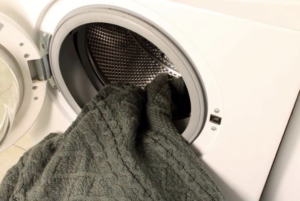
Put a sweater in the wash, and you expect dirt, odours, and maybe a coffee spill to come out. When it comes out clean, nothing seems to be missing. At a much smaller scale, though, movement and friction loosen tiny fibres, and they enter the wash water. When those fibres come from synthetic materials, they are a form of microplastic. Synthetic clothing can also shed fibres during ordinary wear.
Not every microfibre is plastic. Cotton and other natural fabrics shed fibres too. “Microfibre” describes the fibre’s small size, while the material determines whether it is plastic.
The issue isn’t simply that clothes shed. It’s what they shed and where those fibres end up.
Where Do Those Fibres End Up?
The journey doesn’t necessarily end at the drain. Wastewater treatment plants capture a large share of microplastics, but not all of them. Some pass through with treated water. Many captured particles concentrate in sewage sludge, the solid material separated during treatment. When farmers spread that sludge on agricultural land, it can carry microplastics into soil.
This makes textile pollution more complicated than a household laundry problem. The European Environment Agency identifies synthetic textile fibres as the fourth-largest source of unintentional microplastic releases into Europe’s environment.
A note on the evidence: Researchers are still investigating what different levels of microplastic exposure mean for human health. Important gaps remain in the evidence, so it’s worth being cautious about alarming claims. You can take the findings seriously and still respect those uncertainties.
Should We Replace Everything?
Discovering plastic in your clothes might make an all-natural wardrobe sound like the answer. It isn’t that simple. Replacing everything you own would overlook another part of sustainability: using things for longer.
Natural fibres have environmental trade-offs too. The United Nations Environment Programme (UNEP) notes that choosing natural materials can reduce plastic microfibre leakage, but that doesn’t make them impact-free. A label alone can’t tell us the complete environmental story of a garment. A more practical starting point is to care for what we already have. UNEP recommends buying less, keeping clothes longer, and considering reuse and second-hand options.
A few small laundry adjustments may help:
- Wash when needed, rather than after every wear, when possible
- Where care instructions allow, use cold, shorter cycles and full loads without overloading the machine
- Consider a suitable washing-machine microfibre filter, which can capture some fibres before they enter wastewater
These are manageable steps. Nobody needs to become an expert in every fabric they own. Better textile design, manufacturing practices, filtration, and waste management must be part of the response too.
This is also why we’re building a green school. Lasting change doesn’t come from one perfect purchase. It comes from people who understand how materials, water, and waste connect, and who feel confident asking better questions. GSGF wants to help raise those future green leaders.
A Sweater Can Be a Science Lesson
A clothing label may seem like an unlikely place to begin environmental education. Yet it opens the door to chemistry, resource use, water systems, and product design. Students could investigate the materials in a favourite garment, compare how different fabrics are made, or map the journey of water after a wash. A simple repair lesson could introduce another question: what helps us keep an item useful for longer?
Tonight, take one item from your wardrobe and read the label. Choose a material you don’t know much about and find out where it comes from. Perhaps that’s the most useful lesson hidden in a sweater: understanding our environmental impact starts with noticing things we once overlooked.
You can donate to support our first green school, and to keep learning with us, subscribe to our newsletter.
References
01 https://www.eea.europa.eu/en/analysis/publications/plastic-in-textiles-towards-a-circular-economy-for-synthetic-textiles-in-europe/
02 https://www.eea.europa.eu/en/topics/in-depth/textiles
03 https://www.unep.org/news-and-stories/story/inside-clean-seas-campaign-against-microplastics
04 https://www.eea.europa.eu/publications/microplastics-from-textiles-towards-a/microplastics-from-textiles-towards-a/
05 https://www.eea.europa.eu/en/analysis/publications/circularity-of-the-eu-textiles-value-chain-in-numbers
06 https://www.eea.europa.eu/en/european-zero-pollution-dashboards/indicators/impacts-of-microplastics-on-health-signal
07 https://www.unep.org/news-and-stories/story/cleaning-couture-whats-your-jeans
08 https://www.nps.gov/articles/000/laundry_microplastics.htm